

07 Sept 2026 · 8 min read
The problem
Certification bodies typically track enquiries, quotations, audits and certificates through scattered emails and manual records. It's hard to know where any single client stands, and harder still to prepare consistent documentation when the paper trail lives in a dozen inboxes rather than one system.
What we built
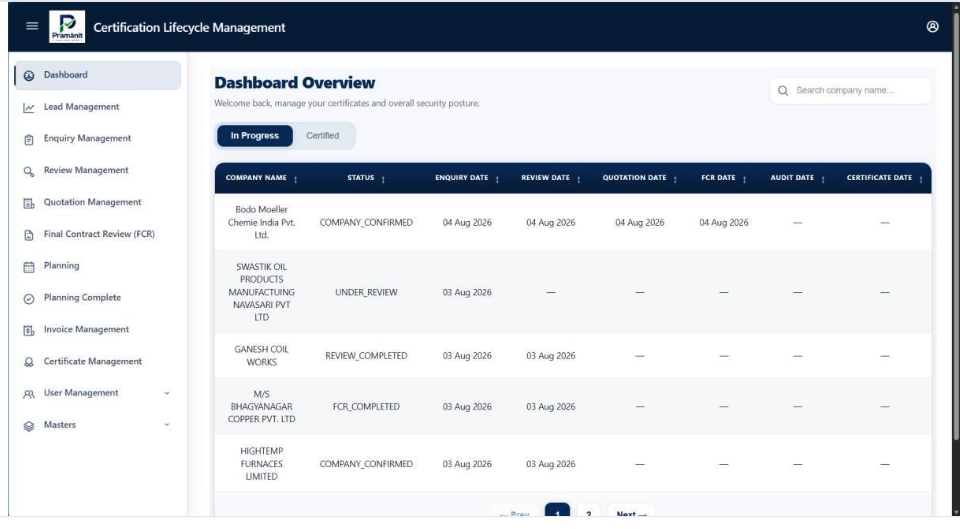
Pramānit follows a client through a fixed nine-stage journey — Lead, Enquiry, Review, Quotation, Final Contract Review, Planning, Planning Complete, Invoice, Certificate — with every stage visible from one dashboard.
-
01
A single dashboard
Every client and exactly which of the nine stages they're at, split between an “In Progress” and a “Certified” view.
-
02
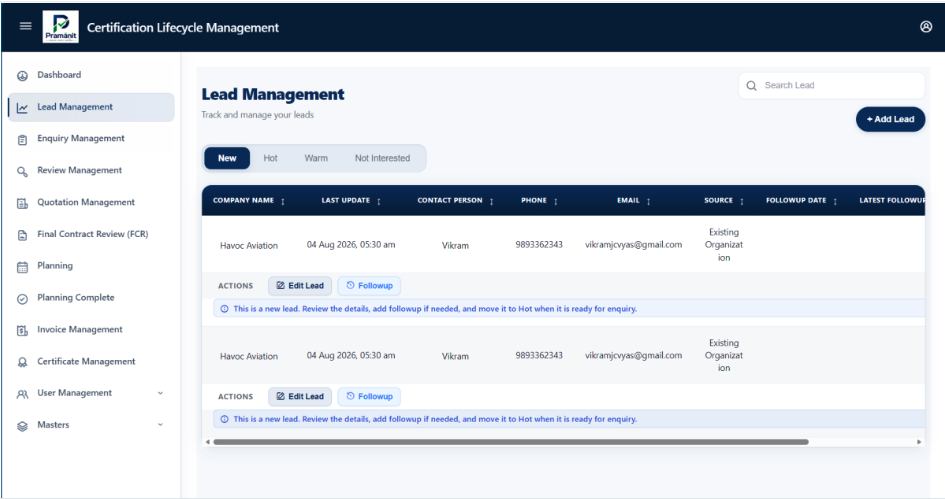
Structured lead and enquiry capture
Leads grouped by how promising they are (New, Hot, Warm, Not Interested) and a formal enquiry form that collects organisation, site, legal status and registration details.
-
03
A guided review workflow
A reviewer selects the matching form template and the system calculates the required audit man-days automatically, using rules configured per standard and complexity rather than a reviewer's memory.
-
04
Quotation and contract handling
Pricing, agreement generation, an emailed quotation, and a lock once the client has agreed — followed by a Final Contract Review as the last checkpoint before an audit is scheduled.
-
05
Audit planning with an Auditor Calendar
A month-by-month view of who's booked where, so two audits are never scheduled against the same auditor by accident.
-
06
Invoicing and certificate issuance
Generated once the audit is locked, with certificate validity and renewal tracked from the same record the enquiry started on.
-
07
Administrative masters
Providers, certificate types, industry (EAC) codes, regions, sources, signatories and review forms — so a certification body can configure its own standards and templates without needing new code for each one.
Screenshot 1
Screenshot 2
What changed
One record instead of a dozen inboxes.
Enquiry, review, quotation, audit and certificate sit on the same client record, so anyone on the team can see where a client stands without checking email threads.
Man-days calculated by rule, not memory.
The Mandays Master ties audit-day estimates to the standard and complexity of the client, so two reviewers reach the same number independently.
New standards don't require new code.
Certificate types, providers, industry codes and review-form templates are all configured through the Masters screens by an administrator.